— The Challenge
A Loved One Can Disappear in Seconds

Wandering and elopement are common behaviors among people with cognitive impairments, including those with autism, dementia, Down syndrome, brain injury, and other cognitive conditions. A child or adult can disappear in seconds from even the most closely supervised environment.
Many individuals who wander are unable to recognize hazards, communicate their location, or help searchers find them. Exposure to weather, traffic, water, and terrain can turn a missing-person incident into a life-threatening emergency.
Every minute
matters when a vulnerable person goes missing. The risks escalate quickly.
— The Challenge
A Loved One Can Disappear in Seconds

Wandering and elopement are common behaviors among people with cognitive impairments, including those with autism, dementia, Down syndrome, brain injury, and other cognitive conditions. A child or adult can disappear in seconds from even the most closely supervised environment.
Many individuals who wander are unable to recognize hazards, communicate their location, or help searchers find them. Exposure to weather, traffic, water, and terrain can turn a missing-person incident into a life-threatening emergency.
Every minute
matters when a vulnerable person goes missing. The risks escalate quickly.
Why Traditional Search Methods Often Aren’t Enough
Public-safety agencies work tirelessly to locate missing individuals — but searches for people with cognitive impairments present unique challenges that traditional methods weren’t designed for.
Traditional Search & Rescue
Extensive resources, uncertain timelines
How the Project Lifesaver Program Works
1
Public-safety agencies become trained, certified, and equipped
Law-enforcement, fire-rescue, emergency-management, and search-and-rescue agencies receive specialized Project Lifesaver training. Their personnel become Certified Electronic Search Specialists (ESS) — trained in the technology, search strategies, and response procedures specific to locating missing individuals with cognitive impairments.
2
Eligible community members enroll
Participating agencies enroll children and adults who meet their program’s eligibility requirements. Each participant receives a personalized transmitter bracelet designed to be worn continuously, emitting a unique radio-frequency signal associated with that individual device.
3
Caregivers report the participant missing
If a participant wanders, caregivers immediately notify local authorities. Because the participant is already enrolled, responding personnel have immediate access to the information needed to begin a targeted search.
4
Certified search specialists track the signal
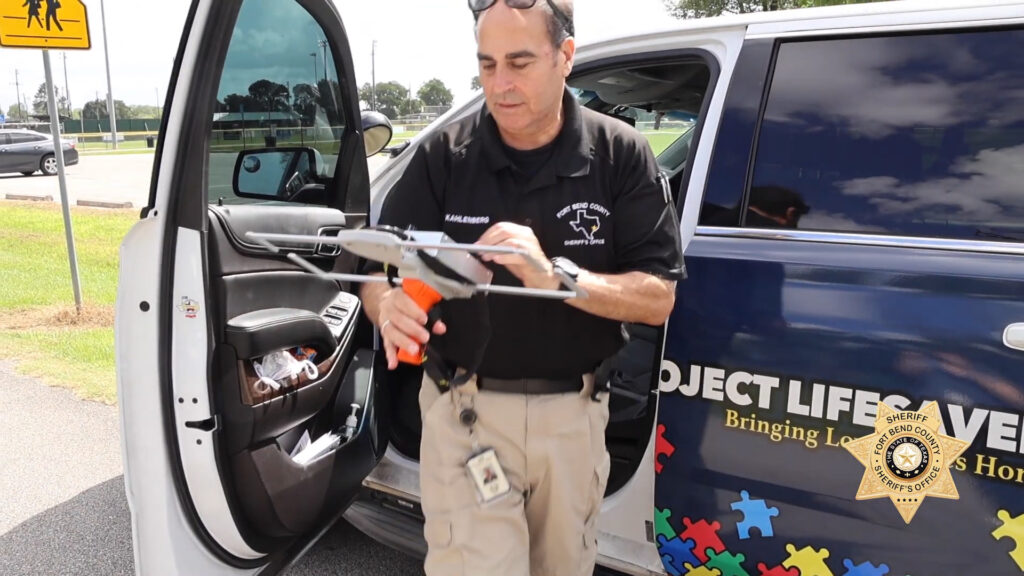
Using specialized receiver equipment, Certified Electronic Search Specialists track the participant’s unique radio-frequency signal — determining direction and strength, and systematically following it toward the participant’s location.
5
The participant is located and brought home
Searchers home in on the participant’s precise location and safely recover them. The technology, training, and methodology work together to dramatically reduce the time required to bring loved ones home.
Why Project Lifesaver Uses Radio Frequency
Radio frequency remains the most reliable, precise, and effective technology available for locating missing children and adults with cognitive impairments.
Unlike commercial devices that rely on GPS or cellular networks, Project Lifesaver’s RF system is specifically designed for search-and-rescue operations — supporting both ground-based and airborne searches.
RF works where GPS and cellular can fail

Densely wooded areas

Remote locations

Urban environments

Large or complex structures

Poor cellular coverage

Even under water
Enrolling a Loved One
The first step is finding out whether a Project Lifesaver member agency serves your community. Use our Find an Agency directory, then contact the agency directly and ask to speak with someone involved in their Project Lifesaver program.
While all member agencies operate within Project Lifesaver standards, each agency administers its own program — enrollment requirements, service areas, fees, and other details may vary from one community to the next.
No program in your area yet? Families, caregivers, community leaders, and local officials have successfully advocated for new programs across North America — and we can help you do the same.
Thousands of Loved Ones Brought Home

Rescue Stories
Recent rescues from member agencies across North America — dynamic feed from the Recent Rescues category.

Testimonials & Reviews
What coordinators, caregivers, and community leaders say about the program — from the Testimonial post type.

In the News
Media coverage of Project Lifesaver rescues and program launches — feed from the In the Media category.
An Affordable Investment in Community Safety
For many agencies and communities, the cost is modest compared with the personnel, equipment, and operational expenses of a single large-scale search effort.
More importantly, it represents an investment in protecting some of a community’s most vulnerable citizens — a case that families, advocates, and government officials can easily make.
Agency Startup Cost
$6,000
Average investment to launch a member agency program